I Made AI My CMO. What It Caught That I Didn’t
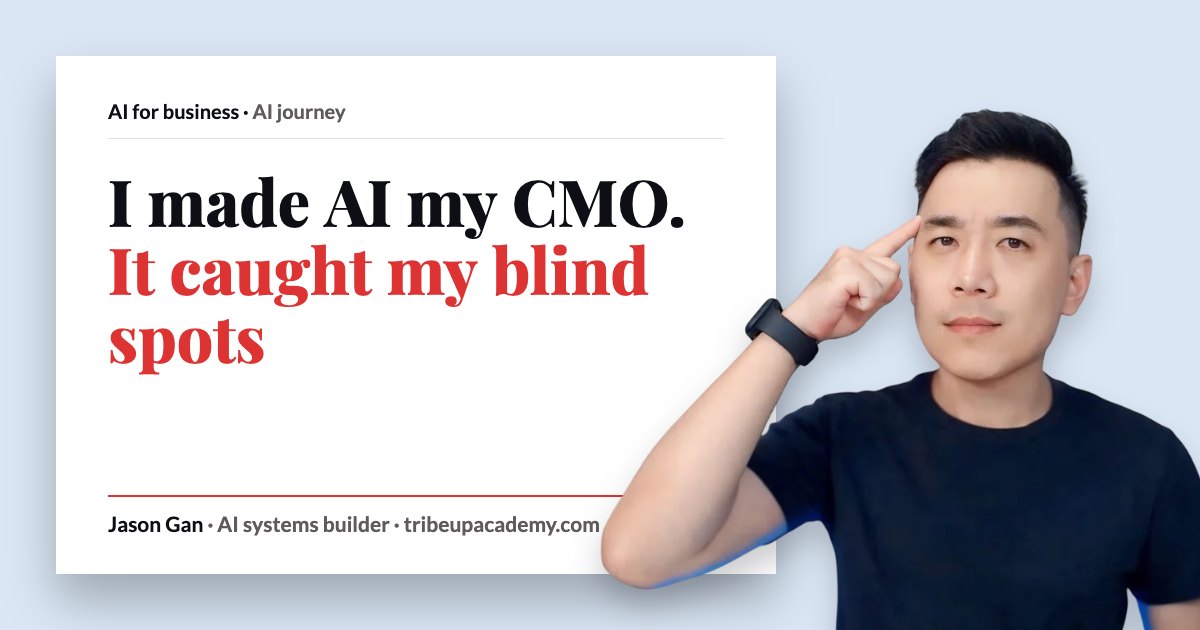
Over the summer I started doing something every business owner should try. Once a month, I asked AI to act as my CMO and give me an honest check-in on my marketing.
It read through my recent work, plans and results, then told me what was working, what wasn’t, and what I was avoiding. It caught things I didn’t want to see, and it was right. Then the check-ins stopped for two months, and I made exactly the mistakes it had warned me about. An AI CMO doesn’t replace your judgment. It gives you a mirror, as long as you keep looking into it.
How the check-in worked
The setup was simple. AI already had my business context: my offers, my plans, my action tracker and my past chats. Once a month I asked for a round-up: look at everything we’ve talked about, executed and planned, and tell me what to do next.
The answer always had the same shape. What actually shipped. The honest read. What had quietly gone stale. A recommended order of what to do next. Each point was tagged with how sure it was: certain, likely or guessing.
Here’s the thing. I asked for honest, and I got honest. That’s the whole point.
What it caught in August
In August, the check-in pointed out a pattern. A few proven things I’d already decided to do had stayed undone for a second month in a row. Meanwhile, I’d built several new things instead: new tools, new offers, new plans.
Its words were roughly this: new initiatives keep pushing out the levers you already know work. I didn’t love reading that. It was true.
What it caught in September
By September it was worse. In five weeks I’d launched a webinar, a new subscription product, a second paid funnel, a corporate training push, a beginner content system and a social media system. For a one-person business.
The check-in caught three things:
- Sprawl. Too many fronts open at once for one person to run well.
- Building on an unproven offer. Several new funnels pointed at a subscription that hadn’t made a single sale yet. Its advice: get one sale before scaling anything pointed at it.
- Neglecting what already worked. My 1-on-1 coaching, my proven recurring income, had been pushed to “next week” every week that month.
See how I build AI marketing systems for businesses →
Real systems built around one business problem, with you or for you, and it always starts with a free 20-minute call.
What I did about it
I acted on it that same day. I replaced the webinar with one simple front-end offer, and I switched my email list back to promoting coaching. That subscription never did sell, and I eventually scrapped it.
Coaching is still the centre of my business today. If the check-in hadn’t called it out, it might have kept sliding.
What happened when the check-ins stopped
After September, I got busy and the monthly check-ins stopped. So did my marketing journal. Two months went by without a step back.
That’s when the reversals happened. My audit offer moved to the front of my funnel, then back, then to the front again. A page was folded into another and brought back six days later. A planned launch was cancelled. My video format changed about five times in four weeks. I wrote about that period in AI made building so easy I built too much.
Remember, the check-in only works if you do it. Now it’s back on my calendar, once a month.
How to set up your own AI CMO check-in
- Give it context first. Your offers, goals, plans, and what you’ve done recently. Without that, you get generic advice.
- Ask for honesty directly. Ask what’s working, what isn’t, what’s stale and what you’re avoiding.
- Ask how sure it is. Certain, likely or guessing, so you know which points to check.
- Make one decision. Don’t just read it. Decide one thing in the same sitting.
- Put it on the calendar. Same day every month. The habit matters more than the prompt.
A quick self-check
- When did you last step back and review your marketing as a whole?
- How many offers or funnels are you running right now, and can you run them all well?
- Is anything you already know works being pushed to next week?
- Are you building more things pointed at an offer that hasn’t sold yet?
- Who tells you honestly when you’re spreading too thin?
If nobody does, a monthly AI check-in is a cheap way to start.
Frequently asked questions
Can AI act as a CMO for a small business?
It can play the review part of the role well: looking at everything you’re doing and telling you honestly what’s working and what isn’t. It works best when it knows your business, offers and recent results. You still make the decisions.
What should I ask AI in a marketing check-in?
Ask what shipped, what’s working, what isn’t, what has gone stale, and what to do next in order. Ask it to say how sure it is about each point. Then make one decision before you close the chat.
How often should I do a marketing review?
Monthly works well for most small businesses. Weekly is too soon to see results, and quarterly is long enough for problems to pile up. In my case, two months without a review was enough for a lot of reversed decisions.
Will AI just tell me what I want to hear?
Not if you ask for honesty and give it the real picture. My check-ins told me things I didn’t want to hear, like that I was spreading myself too thin. If you only share the good news, you’ll only get a good review.
Want someone to look at the whole picture?
If your marketing has turned into many things at once and you’re not sure what to focus on, book a free 20-minute call with me. Just me, no sales team, no obligations. We’ll talk about what you’re running, what’s working, and what to focus on first.
This is part of my AI journey series. Next: I never follow up. So I built a system that does it for me.
Written by Jason Gan. Jason designed software systems for clients from 2010 to 2020 and has run Meta ads since 2010, coaching 6,000+ advertisers across 50+ countries. He now builds marketing systems with AI. Watch him on his YouTube channel.